
A professionally installed epoxy floor lasts 10 to 20 years in residential spaces and 5 to 10 years in heavy industrial use. Surface preparation, traffic load, and maintenance decide the real lifespan. Quality systems with proper topcoats reach 20 years or more, while thin DIY kits often fail within 1 to 3 years.
Key Highlights
- Residential epoxy floors last 10 to 20 years, and professionally installed systems can exceed 30 years.
- Industrial and high-traffic floors last 5 to 10 years because of forklifts, chemicals, and constant abrasion.
- Surface preparation drives longevity, since most early failures trace back to poor concrete grinding and skipped moisture testing.
- 100% solids epoxy outlasts water-based DIY kits by 3 to 5 times under the same conditions.
- A fresh topcoat every 7 to 10 years extends the floor's service life without a full replacement.
How long does an epoxy floor last on average?
An average epoxy floor lasts 10 to 20 years with professional installation and routine care. Light residential use pushes the lifespan past two decades. Warehouses and factories see 5 to 10 years, because heavy machinery and chemical exposure wear the coating faster. These ranges assume a 100% solids system installed over properly profiled concrete. Our commercial epoxy flooring installations reach the upper end of these figures, because each slab is diamond ground and moisture tested before coating.
| Setting | Typical Lifespan |
|---|---|
| Residential garage | 10 to 20 years |
| Basement and interior floors | 15 to 20 years |
| Commercial retail and offices | 7 to 15 years |
| Industrial and warehouse | 5 to 10 years |
| Outdoor driveways and patios | 5 to 12 years |
What factors affect how long epoxy flooring lasts?
The five factors that decide how long epoxy flooring lasts include surface preparation, traffic load, chemical exposure, installation quality, and epoxy type. Surface preparation matters most, since coatings applied over unground or damp concrete peel within months regardless of product grade.
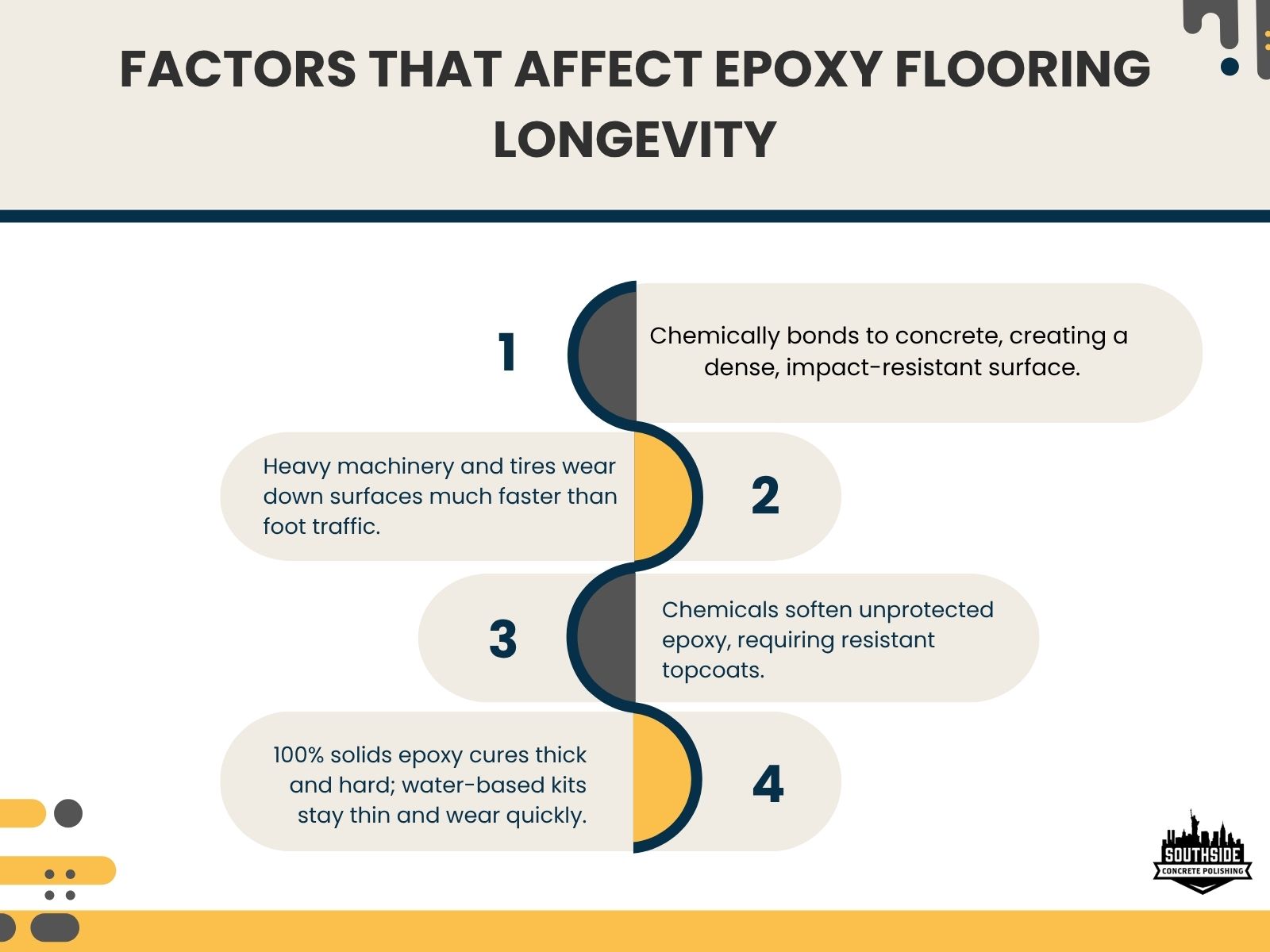
The factors that affact how long epoxy flooring lasts include:
- Surface preparation: Concrete must be diamond ground or shot blasted, moisture tested, and crack repaired before any primer goes down.
- Traffic load: Forklifts, pallet jacks, and vehicle tires abrade the surface far faster than foot traffic in a home garage.
- Chemical exposure: Oil, brake fluid, and solvents soften unprotected epoxy, so kitchens and shops need chemical resistant topcoats.
- Installation quality: A professional applies primer, base coat, and topcoat in measured thicknesses that DIY kits rarely match.
- Epoxy type: 100% solids epoxy cures thick and hard, while water-based kits stay thin and wear through quickly.
How does epoxy flooring lifespan compare to other floors?
Epoxy outlasts most coated and resilient flooring. Epoxy lasts 10 to 20 years, painted concrete needs reapplication every 1 to 3 years, and vinyl tile lasts 5 to 10 years. Polished concrete and polyurea rival epoxy on durability.
| Flooring Type | Typical Lifespan | Key Trade-off |
|---|---|---|
| Epoxy coating | 10 to 20 years | Strong chemical resistance, can yellow under UV |
| Polished concrete | 10 to 15 years | Very durable, lower stain resistance |
| Polyurea and polyaspartic | 10 to 15 years or more | Flexible and UV stable, higher cost |
| Vinyl tile | 5 to 10 years | Cheaper, needs waxing and replacement |
| Painted concrete | 1 to 3 years | Lowest cost, poor chemical resistance |
How can you make an epoxy floor last longer?
You extend an epoxy floor's life by controlling grit, spills, and topcoat wear. Routine cleaning, mats under heavy loads, and a fresh topcoat every 7 to 10 years add 5 to 10 years to the original lifespan. Facilities with forklift traffic must clean epoxy floors with pH neutral cleaners rather than harsh solvents that dull the finish.
To make an epoxy floor last longer:
- Sweep and dust mop weekly, so embedded grit cannot scratch the gloss layer.
- Wipe up oil, gas, and brake fluid quickly, because standing chemicals soften the surface.
- Place mats under jack stands, toolboxes, and vehicle tires to spread point loads.
- Avoid dragging metal shelving or snow shovels that gouge the coating.
- Schedule a topcoat reapplication every 7 to 10 years in high-traffic zones, and keep traffic off each new topcoat through all of its epoxy dry and cure stages.
What are the signs an epoxy floor needs recoating?
An epoxy floor needs recoating when it yellows, blisters, cracks, or peels. These signs mean the topcoat has worn through and the bond is failing. A flooring professional should inspect the slab before fresh coats go down, because a coating that has lost its bond needs full epoxy coating removal first. When a recoat is not enough, some warehouses switch to industrial concrete polishing for a finish that carries no topcoat to wear through. The signs an epoxy floor needs recoating include:
- Yellowing or fading from UV exposure on the topcoat.
- Blistering or bubbling where moisture pushes up from the slab.
- Cracks that telegraph from the concrete below.
- Peeling or flaking edges that signal adhesion loss.
Are epoxy floors high maintenance?
No, epoxy floors rank among the lowest maintenance hard surfaces. A weekly sweep and an occasional mop with a pH neutral cleaner keep the gloss intact. The seamless surface resists dust, stains, and moisture, so no waxing or sealing is needed between topcoat cycles.
Is Polyurea stronger than epoxy?
Yes, polyurea is marketed as 20 times stronger than epoxy. This figure comes from an elongation at break test, where the flexible polyurea stretches far more before snapping. However, when comparing polyurea vs epoxy in terms of abrasion and chemical exposure, high-solids epoxy often matches or beats its competitor.
How much does it cost to epoxy 1000 square feet?
Epoxy flooring for 1,000 square feet costs roughly $4,000 to $12,000 with professional installation, based on $4 to $12 per square foot. DIY kits drop the figure toward $2,000. Material grade, floor prep, and labor drive the final epoxy flooring cost for a project this size.