

How Thick Should a Concrete Driveway Be?
A concrete driveway should be at least 4 inches thick for standard cars and SUVs. Most driveways measure 4 to 6 inches, and the correct thickness depends on vehicle weight, soil type, and climate. Pour the slab too thin and it cracks under load. Pour it thicker than needed and material costs rise fast. This guide gives the exact thickness for each driveway use.
Key takeaways
- A 4-inch slab suits passenger cars and SUVs weighing 3,000 to 6,000 pounds.
- Increase to 5 or 6 inches for trucks, RVs, and frequent heavy loads.
- Going from 4 to 5 inches raises load capacity by about 50 percent and adds roughly 20 percent to concrete cost.
- Slabs of 5 inches or more need steel rebar, while 4 to 5 inch slabs use welded wire mesh.
- A compacted gravel base of 4 to 6 inches supports the slab and prevents cracking.
How thick should a concrete driveway be?
A standard concrete driveway should be 4 inches thick on a compacted gravel base. This depth carries passenger cars and SUVs weighing 3,000 to 6,000 pounds and meets the minimum slab thickness in most local building codes.
Heavier vehicles change the requirement. The table below matches slab thickness, reinforcement, and concrete strength to how the driveway is used.
| Driveway Use and Vehicle Weight | Recommended Thickness | Reinforcement | Typical Strength (PSI) |
|---|---|---|---|
| Cars and SUVs (3,000 to 6,000 lb) | 4 inches | Welded wire mesh | 3,500 to 4,000 |
| Light trucks and daily heavy use | 5 inches | Wire mesh or #3 rebar | 4,000 |
| RVs, boats, and work trucks (12,000 lb and up) | 5 to 6 inches | #3 to #4 rebar grid | 4,000 to 4,500 |
| Commercial and frequent truck traffic | 6 to 8 inches | #4 rebar grid | 4,500 to 5,000 |
What factors change the right concrete driveway thickness?
Three factors push the slab above 4 inches: vehicle weight, weak or clay-heavy soil, and freeze-thaw climate. Each one moves the driveway toward 5 or 6 inches and stronger reinforcement.
Vehicle weight and load
Vehicle weight sets the baseline. A 4-inch slab carries cars and SUVs without trouble. Daily truck use calls for 5 inches. RVs, boats, and work trucks above 12,000 pounds need 5 to 6 inches with a rebar grid set in the middle of the slab.
Soil type and subgrade
Soil decides how the slab is supported. Clay soils expand and contract with moisture, so they need at least 6 inches of concrete to resist movement. Sandy soils shift over time and require firm compaction and a thicker gravel base before the pour.
Climate and freeze-thaw cycles
Climate drives long-term durability. In freeze-thaw regions, a thicker slab poured with air-entrained 4,000 PSI concrete resists frost heave and surface scaling. Pairing the slab with proper drainage and sound concrete waterproofing methods keeps water from undermining the base.
Does a thicker concrete driveway need steel reinforcement?
Yes. Driveways 4 to 5 inches thick use welded wire mesh set at mid-depth. Slabs 5 inches or thicker use #3 or #4 rebar in a grid. Reinforcement does not stop cracks, but it holds any cracks tight and prevents slab sections from shifting.
Edges carry the heaviest tire loads and have support on one side only. For that reason, contractors thicken the slab edge by 1 to 2 inches and place control joints where the apron meets the street.
How much does a thicker concrete driveway cost?
Each added inch raises both material and labor cost. Moving from 4 to 5 inches lifts load capacity by about 50 percent and adds roughly 20 percent to the concrete cost, plus rebar expense once the slab passes 5 inches. Compare those extra costs against your total driveway budget before deciding on a thickness.
What Are the Best Practices for a Long-Lasting Concrete Driveway?
Getting the thickness right is only part of the job. Five installation practices determine whether a correctly sized slab lasts 10 years or starts cracking in a year:
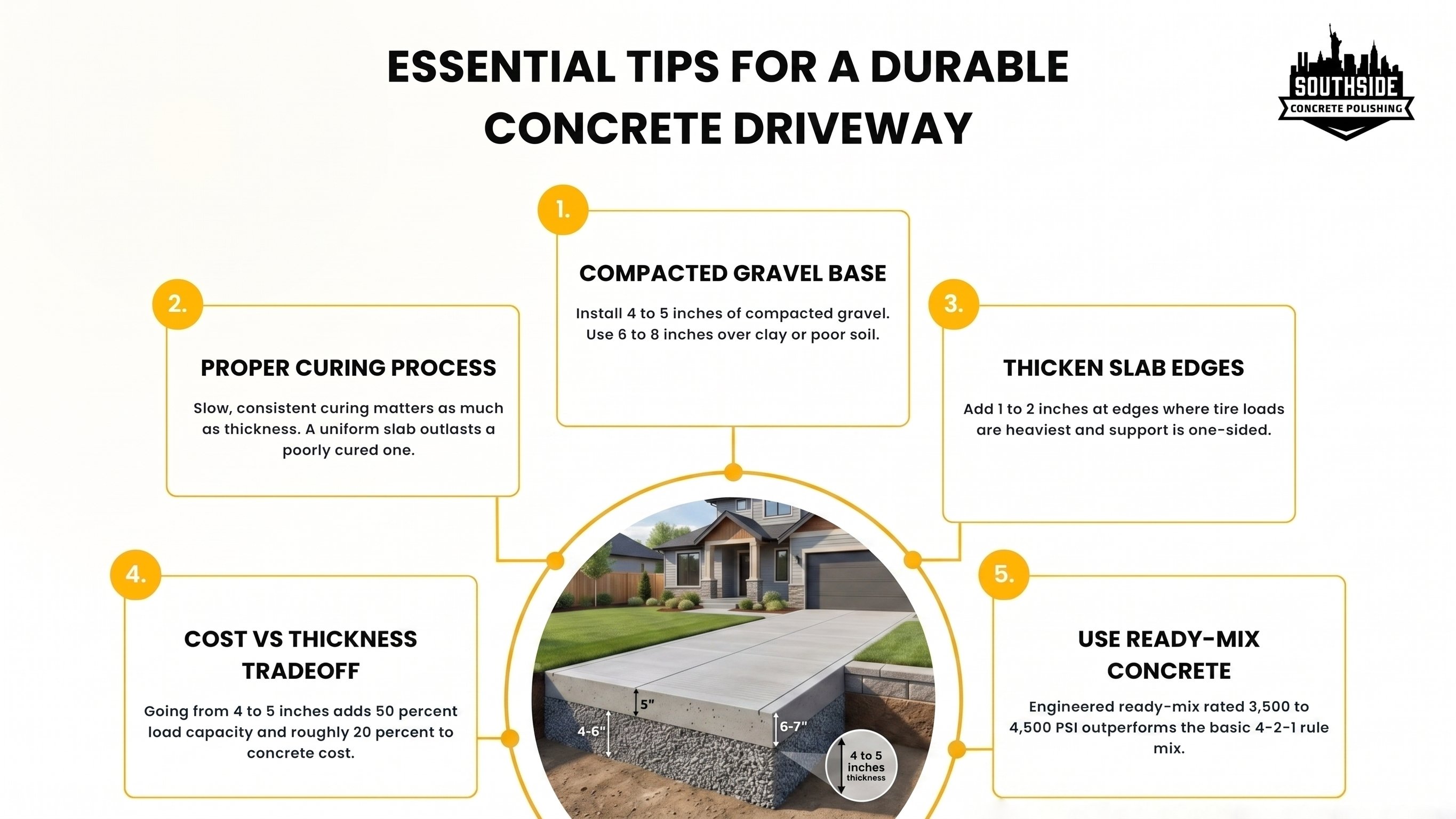
- Install 4 to 6 inches of compacted gravel before the pour, 6 to 8 inches over clay or poor soil.
- Thicken slab edges by 1 to 2 inches where tire loads are heaviest.
- Use engineered ready-mix rated 3,500 to 4,500 PSI rather than a basic site mix.
- Cure the slab slowly and consistently, since a uniform 4-inch slab outlasts a poorly cured thicker one.
- Factor in the cost tradeoff, moving from 4 to 5 inches adds 50 percent load capacity at roughly 20 percent more material cost.
How do control joints protect a concrete driveway?
Control joints force the slab to crack along straight, hidden lines instead of randomly. Space the joints in feet at 2 to 3 times the slab thickness in inches, so a 4-inch slab gets joints every 8 to 12 feet. Cut each joint to one-quarter of the slab depth.
Slow, consistent curing matters as much as thickness. A uniform 4-inch slab on a compacted base outlasts a poorly cured slab that varies from 3 to 5 inches across its surface.
Do you need gravel under a concrete driveway?
Yes. A concrete driveway needs a compacted gravel base of 4 to 6 inches, or 6 to 8 inches over clay or poor soil. The gravel distributes vehicle weight, drains water away from the slab, and stops the subgrade from pumping. Skipping the base lets even strong concrete crack as the ground shifts beneath it.
Should I use a 4-inch or 5-inch concrete driveway?
Use 4 inches for a driveway that only holds cars and SUVs on stable soil. Choose 5 inches if you park trucks or RVs, live in a freeze-thaw climate, or have clay soil. The extra inch adds about 50 percent load capacity and pays off in fewer repairs.
What is the 4-2-1 rule for concrete?
The 4-2-1 rule is a mix ratio of 4 parts gravel, 2 parts sand, and 1 part cement by volume, also written 1:2:4. It produces general-purpose concrete near 2,500 to 3,000 PSI. Driveways perform better with an engineered ready-mix rated 3,500 to 4,500 PSI.
Is thicker concrete less likely to crack?
Thicker concrete resists load and frost cracking, but thickness alone does not prevent shrinkage cracks. A compacted base, spaced control joints, steel reinforcement, and slow curing matter more. If hairline cracks do appear, you can repair cracks in a concrete driveway before they widen.