If you manage a commercial property in New York City or New Jersey, choosing between polished concrete and epoxy flooring is one of the most consequential decisions you will make for your facility. Both systems deliver exceptional durability and low maintenance costs, but they serve different purposes, perform differently in specific environments, and carry different price tags over their full lifecycle.
This guide provides a detailed, side-by-side comparison to help facility managers, property owners, and general contractors determine which flooring system is the right fit for their project.
Overview: Two Proven Commercial Flooring Systems
Polished Concrete
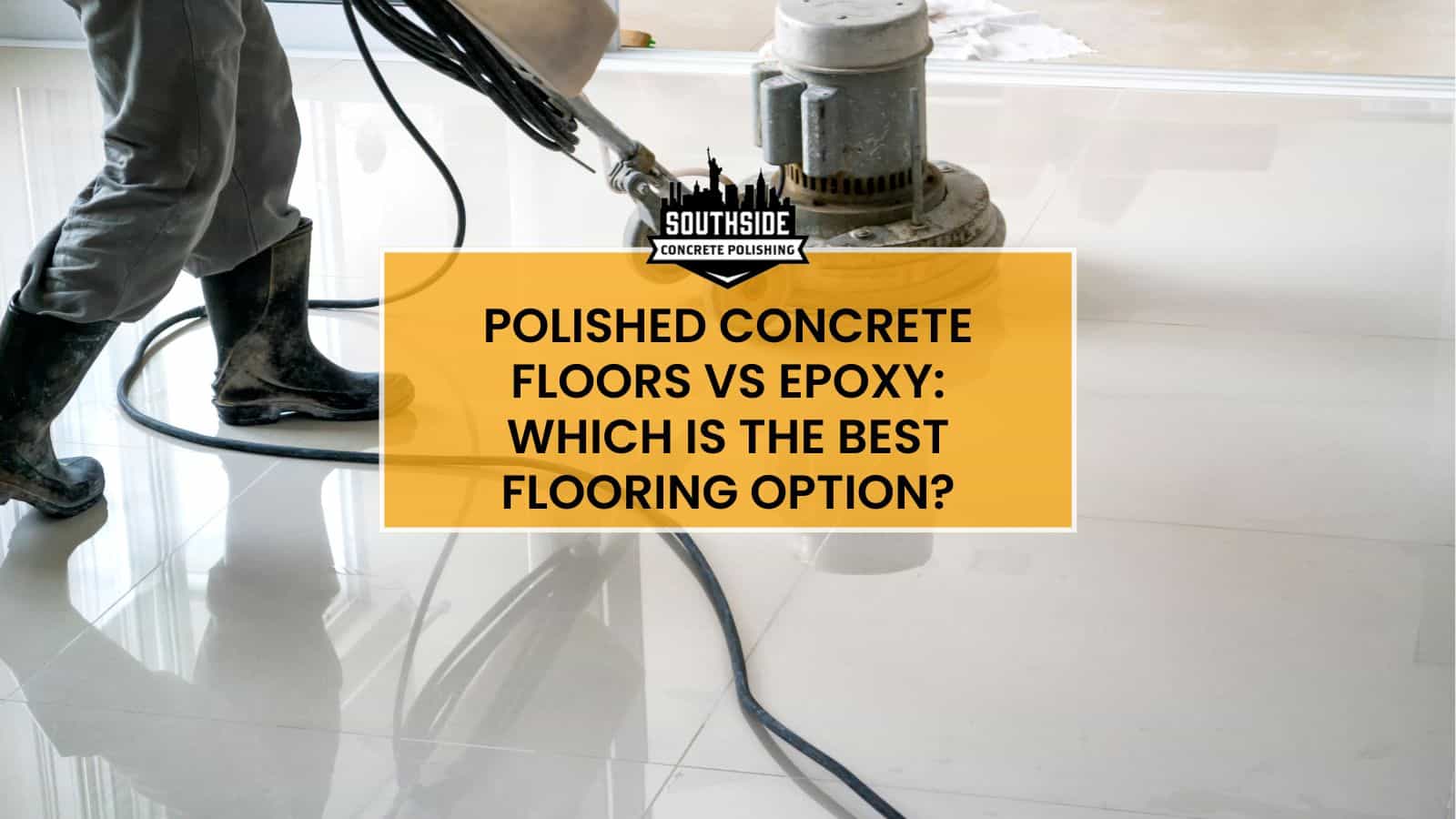
Polished concrete is a mechanical process that transforms an existing concrete slab into a high-performance, reflective floor surface. The process involves grinding the concrete with progressively finer diamond pads (from 30-grit to 1500-grit), applying a chemical densifier to harden the surface, and buffing to the desired sheen level. The result is a permanent, dust-free floor that never needs waxing or stripping.
Polished concrete is not a coating — it is the concrete itself, refined and hardened. This distinction matters because the finish cannot peel, chip, or delaminate. It becomes part of the slab.
Epoxy Flooring
Commercial epoxy flooring is a chemical coating system applied on top of a prepared concrete substrate. Epoxy is composed of two components — resin and hardener — that chemically bond to form an extremely hard, seamless, non-porous surface. The coating typically ranges from 10 to 40 mils thick depending on the application, with options for solid colors, metallic effects, decorative flakes, and custom designs.
Epoxy creates a barrier between the concrete and the environment, providing chemical resistance, impact resistance, and a seamless surface that prevents bacterial growth.
Side-by-Side Comparison
| Factor | Polished Concrete | Epoxy Flooring |
|---|---|---|
| Cost per sqft | $3 – $8 | $5 – $12 |
| Lifespan | 25+ years | 10 – 20 years |
| Installation Time | 3 – 7 days | 2 – 5 days |
| Maintenance Cost | Very low (dust mop only) | Low (mop with neutral cleaner) |
| Chemical Resistance | Moderate | Excellent |
| Slip Resistance | Good (with treatment) | Excellent (with additives) |
| Aesthetics | Natural, sophisticated sheen | Unlimited colors and patterns |
| VOC Emissions | Zero | Low to zero (cured) |
| Repair | Spot re-polish | Section recoat |
| Best For | Offices, retail, lobbies | Kitchens, hospitals, warehouses |
When to Choose Polished Concrete
Polished concrete is the best choice when your primary goals are aesthetics, sustainability, and long-term cost efficiency. Here are the scenarios where polished concrete outperforms epoxy:
Corporate Offices and Lobbies
Modern office design has increasingly moved toward exposed concrete for its clean, industrial-chic aesthetic. A high-gloss polished concrete floor in a lobby or open-plan workspace communicates professionalism and modernity. The surface reflects natural light, reducing artificial lighting needs and contributing to LEED certification credits.
Retail Spaces and Showrooms
Polished concrete creates a premium retail environment that elevates brand perception. The mirror-like finish in high-traffic retail areas withstands foot traffic from hundreds of daily visitors without showing wear. Unlike epoxy, polished concrete improves with foot traffic over time — the surface actually becomes smoother and more reflective.
Budget-Conscious Large-Area Projects
For projects over 10,000 square feet where cost control is essential, polished concrete delivers significant savings. At $3–$8 per square foot versus $5–$12 for epoxy, the difference on a 20,000 sqft project could be $40,000–$80,000. The lower lifecycle maintenance costs amplify this savings over 10+ years.
Sustainable Building Programs
Polished concrete earns LEED credits because it uses the existing concrete slab (no new materials manufactured), eliminates VOC-emitting adhesives and coatings, and improves energy efficiency through light reflectivity. For facility managers pursuing sustainability certifications, polished concrete is often the default recommendation.
When to Choose Epoxy Flooring
Epoxy flooring is the right choice when you need chemical resistance, seamless hygiene, or heavy-duty impact protection. These are the environments where epoxy is the clear winner:
Healthcare Facilities and Hospitals
Healthcare environments require seamless, non-porous surfaces that meet CDC/CMS compliance standards. Epoxy delivers this with antimicrobial additives, integrated cove base (eliminating floor-to-wall joints), and complete chemical resistance to harsh disinfectants. Polished concrete, while excellent in many settings, cannot match epoxy's seamless hygiene properties.
Commercial Kitchens and Food Service
Commercial kitchens expose floors to grease, acids, hot water, and thermal shock daily. Epoxy coatings — particularly urethane cement and novolac formulations — are specifically engineered for these conditions. The seamless surface prevents food particles from accumulating in joints or cracks, meeting USDA and FDA requirements.
Industrial Warehouses and Manufacturing
For facilities with forklift traffic, chemical exposure, and 24/7 operations, heavy-duty epoxy systems provide the impact resistance and chemical protection that polished concrete alone cannot match. Epoxy mortar floors (100% epoxy solids with graded quartz) create the strongest seamless flooring system available for industrial environments.
Decorative and Brand-Forward Spaces
When the floor needs to be a design statement — metallic swirls, custom brand colors, embedded logos, or decorative flake patterns — epoxy offers creative possibilities that polished concrete cannot replicate. Metallic epoxy creates stunning 3D depth effects that transform a floor into a focal point.
Cost Breakdown: Initial and Lifecycle
Initial Installation Costs
- Polished Concrete: $3–$8 per square foot. A 10,000 sqft office project typically runs $40,000–$60,000.
- Epoxy Flooring: $5–$12 per square foot. The same 10,000 sqft space with a standard epoxy system runs $60,000–$90,000.
Annual Maintenance Costs
- Polished Concrete: $0.05–$0.10 per square foot per year. Maintenance consists of dust mopping and occasional damp mopping. No waxing, no stripping, no recoating — ever.
- Epoxy Flooring: $0.10–$0.25 per square foot per year. Maintenance includes regular mopping with a neutral pH cleaner. High-traffic areas may need a topcoat refresh after 5–7 years ($1–$3/sqft).
10-Year Total Cost of Ownership
For a 15,000 sqft commercial space:
| Cost Component | Polished Concrete | Epoxy Flooring |
|---|---|---|
| Installation | $75,000 | $105,000 |
| Annual Maintenance (10 yr) | $11,250 | $26,250 |
| Mid-Life Recoat | $0 | $30,000 |
| 10-Year Total | $86,250 | $161,250 |
Polished concrete delivers a 46% lower total cost of ownership over 10 years in typical commercial settings. However, if your facility requires chemical resistance or seamless hygiene (healthcare, food service), the additional cost of epoxy is justified by its performance characteristics.
Maintenance Comparison
Polished Concrete Maintenance
Daily maintenance for polished concrete consists of dry dust mopping to remove debris. Weekly, a damp mop with clean water is sufficient. No chemicals, no specialized equipment, no periodic recoating. The surface is permanently sealed through the densification process and will maintain its sheen for decades with this basic routine.
Epoxy Flooring Maintenance
Epoxy floors require regular sweeping or dust mopping followed by wet mopping with a neutral pH cleaner. Avoid harsh chemicals or abrasive cleaners that could dull the surface. In high-traffic industrial environments, periodic auto-scrubbing maintains the finish. After 5–7 years of heavy use, a topcoat refresh extends the system's appearance and performance.
Installation Disruption and Downtime
Both systems require some facility downtime, but the profiles differ:
Polished concrete installation takes 3–7 days for most commercial projects. The grinding process generates noise and vibration, but dust is controlled with industrial vacuum systems. Traffic can resume approximately one hour after the final buff. The process can be phased by zone to keep portions of the facility operational.
Epoxy flooring installation takes 2–5 days, but the curing period adds additional restricted-access time. Light foot traffic is typically allowed after 24 hours, with full traffic after 72 hours. The mixing and application process produces mild odor (though modern low-VOC formulations have reduced this significantly). Surface preparation grinding is the noisiest phase.
For occupied facilities where downtime must be minimized, both systems can be installed during after-hours shifts (evenings, weekends, and holidays). We regularly complete full commercial installations without a single hour of business interruption by phasing the work around your operating schedule.
Making Your Decision
The choice between polished concrete and epoxy comes down to your facility's specific requirements:
Choose polished concrete if: You prioritize aesthetics, sustainability, and long-term cost savings. Your space is an office, retail store, lobby, showroom, or educational facility. You want zero ongoing maintenance costs beyond basic cleaning.
Choose epoxy if: You need chemical resistance, seamless antimicrobial surfaces, or maximum impact protection. Your space is a hospital, kitchen, manufacturing plant, or warehouse with chemical exposure. You want unlimited color and design customization.
Consider combining both: Many facilities use polished concrete in client-facing areas (lobbies, offices, showrooms) and epoxy in back-of-house or industrial areas (kitchens, loading docks, warehouses). This hybrid approach optimizes both cost and performance.
Get a Professional Assessment
The best way to determine which system is right for your facility is a professional on-site assessment. Our team evaluates your concrete condition, traffic patterns, chemical exposure, aesthetic goals, and budget to recommend the optimal flooring solution.
Contact us for a free consultation and estimate. We serve all five NYC boroughs and New Jersey, with after-hours installation available at no additional charge. Call 917-746-1992 to discuss your project with our flooring specialists.