Yes, epoxy flooring is ideal for basements. Epoxy flooring in commercial basements offers significant advantages, including waterproofing, durability, and low maintenance, but also requires precise preparation and environmental conditions to perform well long-term. In global industrial settings, correctly applied epoxy basement coatings last over 20 years under heavy load, moisture, and usage, provided substrate moisture is controlled.
Epoxy flooring is a two-component system combining resin and hardener, which cures into a seamless, non-porous surface. That surface resists water vapor, protects concrete from seepage, inhibits mold growth, and adds aesthetic flexibility with options like flakes, metallic effects, or solid colors.
Epoxy offers value only when factors such as moisture vapor barriers, substrate prep, curing conditions, and ventilation are carefully addressed for commercial basements, used for storage, utilities, or workshops.
Why Should You Use Epoxy Flooring in a Basement?
You should use epoxy flooring in a basement because it delivers a durable, moisture-resistant, and seamless surface that stands up to heavy use while improving overall protection and appearance. Epoxy performs exceptionally well when the basement environment meets key conditions: low substrate moisture, stable temperatures, controlled ventilation, and consistent foot or equipment traffic.
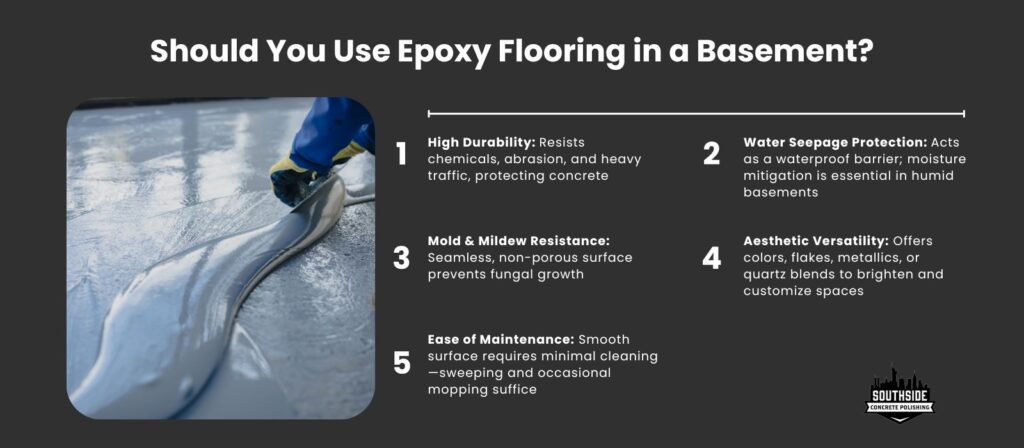
The following are the reasons for using epoxy flooring in a commercial basement:
High Durability
Epoxy floors resist chemical spills, abrasion, and heavy traffic far better than standard basement paints or sealers. Their dense surface structure protects the underlying concrete from mechanical and chemical damage.
Water Seepage Protection
Epoxy acts as a waterproof barrier that blocks moisture from seeping through foundations or damp concrete slabs. A moisture mitigation system should be installed first to prevent bubbling or peeling in basements with high humidity.
Mold and Mildew Resistance
Because epoxy creates a seamless, non-porous layer, it prevents moisture penetration that supports fungal growth. This makes it ideal for environments where humidity and dampness are recurring issues.
Aesthetic Versatility
Epoxy offers numerous design options such as solid colors, flakes, metallic effects, or quartz blends. These finishes brighten dark basement spaces and are customized to match commercial interiors or branding themes.
Ease of Maintenance
The smooth, sealed surface of epoxy floors requires minimal upkeep. Routine sweeping and occasional mopping with mild cleaners keep the floor spotless, reducing long-term maintenance costs.
How Does Epoxy Flooring Work in Basement Concrete?
Epoxy flooring works in a basement concrete by forming a chemical bond with a properly prepared substrate, sealing pores, and incorporating a moisture vapor barrier to resist dampness. The process begins with grinding or profiling the concrete to expose aggregate and remove old coatings or sealers. Next, a moisture vapor barrier or primer is applied to manage water vapor transmission.
The epoxy resin and hardener are mixed accurately and applied within the recommended temperature and humidity ranges. Once cured, the epoxy forms a rigid, seamless coating that limits capillary water intrusion and surface moisture, improving resistance to seepage and helping maintain structural integrity.
What Advantages Does Epoxy Flooring Offer in Commercial Basements?
The advantages of using epoxy flooring in commercial basements include durability, moisture protection, hygiene, design versatility, easy maintenance, and long lifespan. These benefits of epoxy flooring make it an ideal choice for high-traffic, industrial, or storage areas where a resilient, low-maintenance, and visually appealing floor is essential.
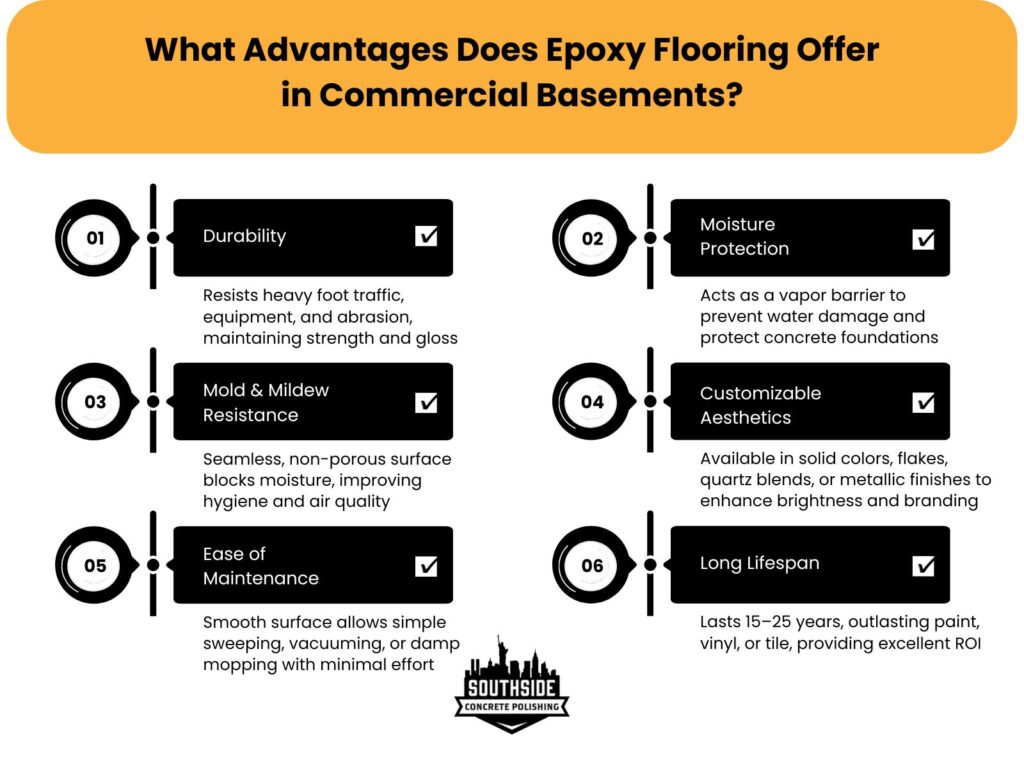
The following are the advantages of using epoxy flooring in commercial basements:
-
Durability Under Wear: Epoxy floors withstand continuous foot traffic, equipment movement, and storage impact. The cured resin surface resists scratching and abrasion, maintaining strength and gloss even under heavy mechanical loads.
-
Moisture Protection: When installed over a proper vapor barrier, epoxy minimizes water vapor transmission and prevents moisture from weakening the concrete foundation. This is essential in below-grade environments where dampness is common.
-
Mold and Mildew Resistance: The non-porous, seamless structure of epoxy prevents moisture absorption, depriving mold and mildew of the conditions they need to grow. This enhances indoor hygiene and air quality in enclosed basements.
-
Customizable Aesthetics: Epoxy coatings come in solid colors, decorative flakes, quartz blends, and metallic finishes. These customizable options increase brightness and create professional or branded environments suitable for workrooms or display areas.
-
Ease of Maintenance: The smooth epoxy surface allows quick cleaning with basic tools, sweeping, vacuuming, or damp mopping with a pH-neutral cleaner, keeping maintenance costs and labor minimal.
-
Long Lifespan: Properly installed commercial epoxy systems last 15--25 years on average, significantly outlasting basement paints, vinyl, or tile options. This longevity ensures a strong return on investment for property owners.
What Challenges Come with Epoxy Flooring in Basements?
The challenges that come with epoxy flooring in basements include moisture control, surface preparation, ventilation, temperature stability, and application complexity. Epoxy flooring presents unique challenges in basements because of environmental, material, and installation factors that affect adhesion, curing, and long-term durability.
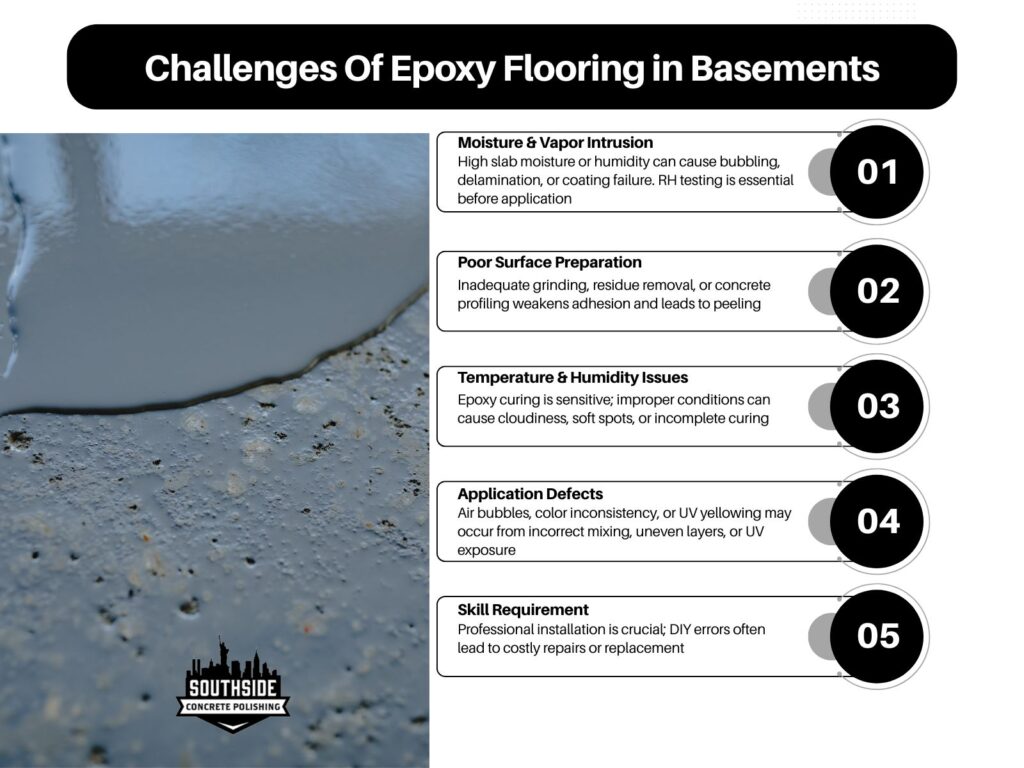
The challenges that come with epoxy flooring in basements are as follows:
-
Moisture and vapor intrusion: If slab moisture or relative humidity levels are too high, the epoxy bubble, delaminate, or fail. Relative humidity testing (RH probes) is necessary to ensure acceptable moisture levels before coating.
-
Poor substrate preparation: Failure to diamond grind, remove residues, or properly profile the concrete leads to weak bonding and peeling.
-
Temperature, humidity, and curing problems: Epoxy cures via chemical reaction, and unfavorable humidity or temperature interfere with the treatment, leading to cloudiness, soft spots, or incomplete performance.
-
Air bubbles, color inconsistency, UV yellowing: These defects arise when mixing is incorrect, layers are too thick or thin, or UV-exposed strains degrade resin.
-
Skill required: Epoxy basement flooring demands precision, correct product selection, and professional craftsmanship to avoid long-term failure. DIY errors result in costly replacements.
How Do Epoxy Floors Compare to Other Basement Flooring Alternatives?
You can compare epoxy floors to other basement flooring alternatives by evaluating durability, moisture resistance, maintenance, and cost.
Epoxy flooring is compared to other basement flooring alternatives in the following ways:
How to Ensure Epoxy Basement Floors Perform Well?
To ensure epoxy basement floors perform well, proper preparation, environmental control, and product selection are essential.
The following features and processes help achieve optimal durability and finish:
-
Moisture Testing and Vapor Barrier Installation: Conduct RH or calcium chloride tests to confirm the substrate's moisture transmission rate is below 75% RH for most epoxy systems. Apply a moisture vapor barrier if readings exceed recommended limits.
-
Substrate Profiling and Surface Preparation: Grind or shot-blast the concrete to the correct surface profile (CSP-2 to CSP-3). Remove oils, old coatings, and dust to ensure maximum adhesion.
-
High-Quality Epoxy System: Select epoxy products with UV stability, high solids content, and verified impact resistance. Use formulas designed for below-grade or high-humidity environments.
-
Proper Mixing, Layering, and Curing Conditions: Follow manufacturer instructions for mix ratios, temperature, humidity, and recoat windows. Consistent curing ensures hardness and chemical resistance.
-
Ventilation and Odor Control: Basements lack adequate airflow. Use mechanical ventilation or temporary exhaust systems during installation to disperse fumes and maintain safe working conditions.
How Can You Mitigate Risk when Installing Epoxy Floors in Basements?
You can mitigate risk when installing epoxy floors in basements by addressing the following common failure points proactively:
-
Seal cracks and repair structural damage before application.
-
Use vapor barriers or moisture mitigation primers when RH or slab moisture is detected.
-
Avoid applying under direct sunlight or extreme cold; maintain optimal temperature/humidity conditions.
-
Opt for UV-stable topcoats if any daylight is present via windows.
-
Monitor for air bubbles or delamination soon after installation and address small defects early.
Can the Same Epoxy Used in Basements Be Applied to Commercial Floors?
Yes, the same epoxy used in basements can be applied to commercial floors, provided it meets the specific performance requirements of the commercial environment. While basement epoxy is formulated to handle moisture and below-grade conditions, commercial floors face heavy traffic, machinery, and chemical exposure.
Using a commercial epoxy flooring ensures sufficient thickness, chemical resistance, and durability to withstand these stresses, making it suitable for both settings when the formulation matches the floor's demands.
What Factors Affect the Epoxy Flooring Cost?
The cost of epoxy flooring depends on surface preparation, type of epoxy (metallic, quartz, or standard), project size, labor rates, and optional decorative finishes. Installation complexity, such as repairing cracks or leveling uneven floors, also influences the total expense.
Facilities with heavy machinery or high foot traffic require thicker or more durable coatings. This increases material costs and eventually the overall epoxy flooring cost. Considering these factors ensures accurate budgeting and project planning.
How Can You Ensure Slip Resistance in Epoxy Flooring?
Slip resistance in epoxy flooring is achieved through surface texturing, adding anti-slip aggregates, or selecting specialized coatings designed for traction. These techniques prevent slips and falls in high-traffic or wet environments, making the floor safer for employees and visitors.
Proper curing and ongoing maintenance help preserve slip resistance over time, maintaining safety in commercial and industrial basements. The use of aggregates, textured coatings, and formulation adjustments are key methods to achieve a durable,slip resistant epoxy flooringsurface.