An epoxy floor takes 10 to 18 hours to dry enough for light foot traffic and 48 hours to 3 days to cure enough for vehicles, based on manufacturer schedules tested near 70°F. Product type, floor temperature, and humidity move every one of these numbers.
New York City winters stretch those times further. The National Weather Service lists a normal Central Park high of 39°F to 41°F in early January, below the 60°F minimum printed on common epoxy kits.
Every epoxy floor timeline starts with the difference between a floor that feels dry and a floor that has cured.
Key Takeaways
- Rust-Oleum rates its EpoxyShield garage kit for heavy items at 24 to 48 hours and vehicles at 3 days, based on testing at 70°F and 50% relative humidity.
- Epoxy cure rate halves with every 18°F drop in temperature, according to Chemco Systems, and most ambient-cure epoxies nearly stop curing between 35°F and 40°F.
- A floor that feels dry to the touch still carries a soft film beneath the surface, and parking on that film causes hot tire pickup.
- Watco caps the recoat window on High Build Epoxy 100 at 48 hours, so a two-coat garage floor takes 4 to 5 days from moisture test to parking.
What Is the Difference Between Epoxy Drying and Curing?
Epoxy drying is the point where the coating surface stops feeling wet, and epoxy curing is the chemical cross-linking of resin and hardener that builds full hardness and chemical resistance. Epoxy resin is a liquid polymer that hardens only after it reacts with a hardener, usually an amine compound.
Cross-linking is that reaction, in which hardener molecules bond resin chains into a rigid three-dimensional network. 100% solids epoxy contains no water or solvent, so drying and curing come from one reaction observed at different milestones.
Water-based epoxy, the type sold in most garage kits as epoxy floor paint, also releases water as it sets. Solvent-borne epoxy releases solvent. That evaporation step is why water-based and solvent-borne products post different early dry times than 100% solids systems.
ASTM International standard D1640 defines the test methods for measuring the drying and curing stages of organic coatings under controlled temperature and humidity. The 4 milestones an epoxy floor coating passes through between mixing and full service are:
- Tack-free: The surface no longer sticks to a light touch, but the film underneath remains soft.
- Dry-hard: The film resists firm pressure without marking, which is where light foot traffic begins.
- Recoat window: The next coat bonds chemically to the previous one without sanding during this period.
- Full cure: The coating reaches its rated hardness, chemical resistance, and load capacity.
Each epoxy milestone arrives at a speed set by the curing reaction itself.
Why Does an Epoxy Floor Take Time to Cure?
Epoxy floor coatings cure through an exothermic reaction in which amine hardener molecules bond to epoxy resin, at a speed set by floor temperature, film thickness, and mixed batch mass. An exothermic reaction releases heat as it proceeds.
How Does Temperature Change the Epoxy Curing Reaction?
Temperature doubles or halves the epoxy cure rate for every 18°F (10°C) change, according to Chemco Systems and Astro Chemical. Chemco gives the example of an epoxy that thickens in 25 minutes at 73°F and takes about 100 minutes at 37°F.
Most ambient-cure epoxies nearly stop reacting between 35°F and 40°F, according to Chemco Systems. The 18°F rule applies only inside the application range printed on the product's technical data sheet.
Why Do Thick Coats and Large Batches Cure Differently?
Mixed epoxy mass generates its own heat, so a full bucket cures faster than the same epoxy spread thin across a floor. Pot life is the working time between mixing and the point where the material thickens too far to spread.
Watco limits High Build Epoxy 100 applications to small sections because of its short pot life. A thin epoxy film on cold concrete loses reaction heat to the slab, which slows curing at the floor surface.
Those reaction speeds translate into fixed milestones on every epoxy manufacturer's data sheet.
How Long Does Epoxy Floor Take to Dry at Each Stage?
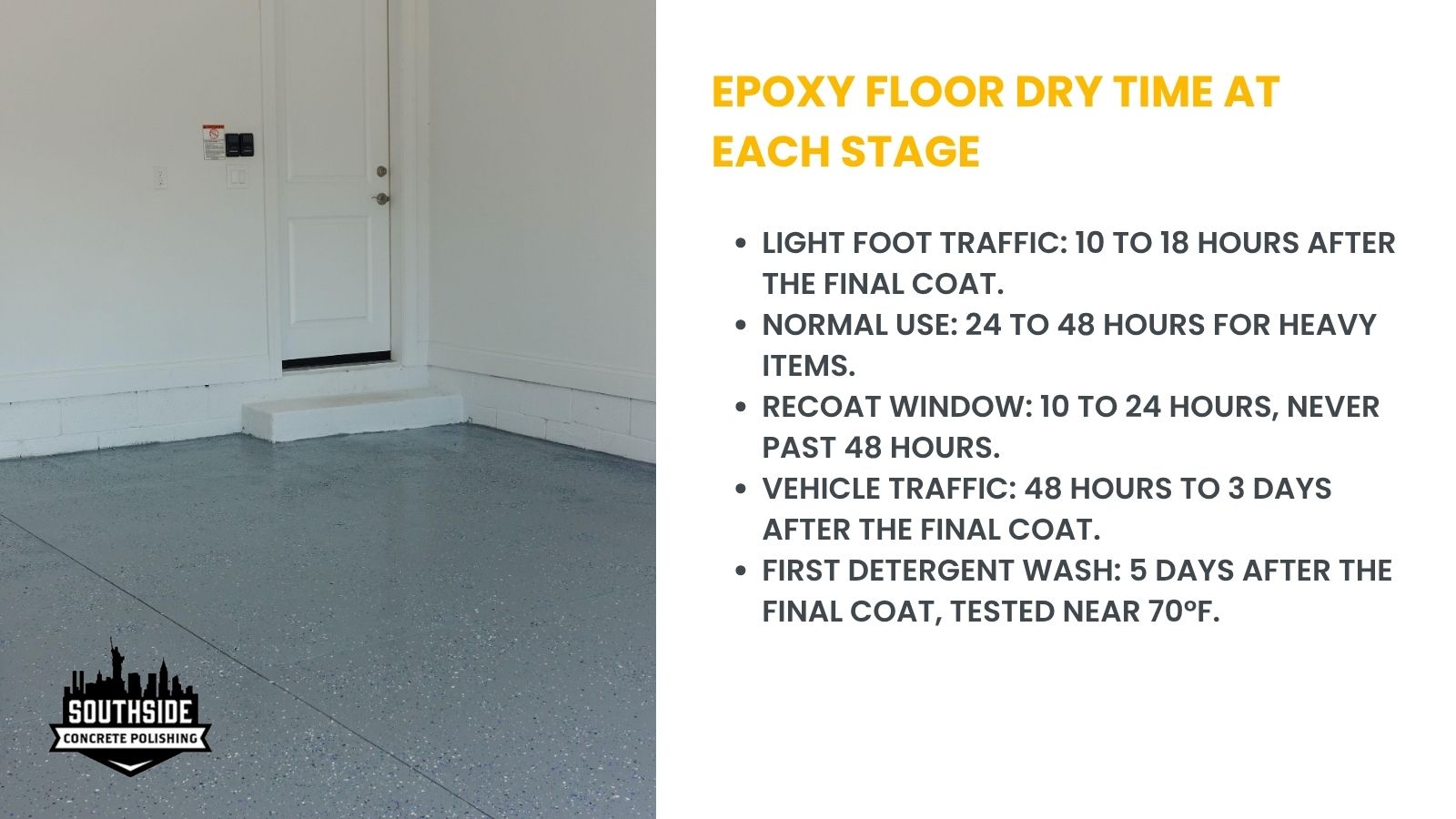
Epoxy floor dry time runs 10 to 18 hours to light foot traffic, 24 to 48 hours to normal use, and 48 hours to 3 days to vehicle traffic near 70°F.
How long epoxy floor takes to dry at each stage varies by product, measured on data sheets tested at 70°F to 80°F. The table below compares 3 published epoxy schedules: a water-based garage kit, a 100% solids industrial coating, and an industrial topcoat. "Not published" marks a milestone the manufacturer does not list.
| Milestone | Water-based kit (Rust-Oleum EpoxyShield, 70°F, 50% RH) | 100% solids (Watco High Build Epoxy 100, 70°F to 80°F, 50% RH) | Industrial topcoat (CFS High Performance Epoxy Top Coat) |
|---|---|---|---|
| Light foot traffic | 12 to 16 hours | 10 hours | 14 to 18 hours |
| Normal use or heavy items | 24 to 48 hours | 24 hours | Not published |
| Recoat window | Not published | 10 to 24 hours, 48 hours maximum | Not published |
| Vehicle traffic | 3 days | 48 to 72 hours | Not published |
| First detergent wash | Not published | 5 days | Not published |
| Full cure | 3 days | 48 to 72 hours for full use | 2 to 7 days for heavy traffic |
How Long Before You Can Walk on an Epoxy Floor?
Light foot traffic on an epoxy floor starts 10 to 18 hours after the final coat across the 3 schedules above. Watco allows it at 10 hours, Rust-Oleum at 12 to 16 hours, and Concrete Floor Solutions at 14 to 18 hours.
Light foot traffic means soft-soled shoes or socks, not rolling carts, ladders, or furniture. Rust-Oleum holds heavy items and normal foot traffic on EpoxyShield until 24 to 48 hours after application.
How Long Before You Can Drive on an Epoxy Garage Floor?
Vehicle traffic on an epoxy garage floor starts 48 to 72 hours after the final coat on Watco High Build Epoxy 100 and at 3 days on Rust-Oleum EpoxyShield. Garage floor epoxy dry time for parking always runs longer than the wait for walking.
Hot tire pickup is the failure that early parking causes. Warm tires soften an uncured epoxy film, and the coating lifts off the slab as the tires cool. The 5 to 7 day waits some guides quote describe first washing and full chemical resistance, not parking, on these two systems.
The calendar for a full epoxy garage floor project stacks these milestones end to end.
How Long Does It Take to Epoxy a Garage Floor From Start to Finish?
A two-coat epoxy garage floor takes 4 to 5 days from moisture test to parking. A newly poured slab needs 28 days of concrete curing before epoxy coating starts, according to both Rust-Oleum and Watco.
The 6 stages of a two-coat epoxy garage floor schedule are:
- Day 0 covers a 24-hour moisture test, in which a 2-foot by 2-foot plastic sheet taped to bare concrete shows condensation when slab moisture needs a barrier first.
- Day 1 covers surface preparation, crack repair, and the base coat, following the full epoxy application sequence on the first working day.
- Day 2 covers the topcoat, applied 10 to 24 hours after the base coat on Watco High Build Epoxy 100 and never past 48 hours.
- Day 2 to 3 covers light foot traffic, allowed 10 to 16 hours after the topcoat.
- Day 4 to 5 covers vehicle traffic, allowed 48 hours to 3 days after the topcoat.
- Day 7 covers the first detergent wash, allowed 5 days after the final coat on Watco High Build Epoxy 100.
Single-coat water-based kits such as Rust-Oleum EpoxyShield shorten this epoxy garage floor cure time by 1 day, because the kit applies in one coat. Every date in the schedule shifts with the conditions inside the garage.
What Factors Change Epoxy Floor Cure Time?
Epoxy floor cure time changes with 6 conditions: floor temperature, dew point, relative humidity, film thickness, product chemistry, and moisture vapor rising through the concrete slab. Each condition shifts the manufacturer schedule in a predictable direction.
The 6 conditions that change epoxy floor cure time work as follows:
- Floor temperature: Concrete temperature controls the reaction where the epoxy bonds to the slab, and Rust-Oleum and Watco both set a 60°F minimum for application.
- Dew point: Dew point is the temperature at which water condenses out of the air, and Polytek prohibits application when the surface sits less than 5°F above it.
- Relative humidity: Polytek and Concrete Floor Solutions cap application humidity at 85%, and higher humidity produces amine blush on amine-cured epoxies.
- Film thickness: Thick epoxy coats hold reaction heat, while thin coats on cold concrete lose it to the slab.
- Product chemistry: Water-based, solvent-borne, and 100% solids epoxies publish different schedules, as the stage table shows.
- Slab moisture: Moisture vapor emission is water vapor rising through concrete, and Polytek sets a ceiling of 4.5 pounds per 1,000 square feet per 24 hours. Vapor emission is a common problem with basement slab moisture.
The table below applies the 18°F rule to an epoxy milestone rated at 24 hours at 70°F. The values are estimates, not specifications, and hold only inside the product's printed application range.
| Floor temperature | Estimated time to a 24-hour milestone |
|---|---|
| 88°F | About 12 hours |
| 70°F | 24 hours |
| 52°F | About 48 hours, below the 60°F minimum on Rust-Oleum and Watco sheets |
| 40°F and below | Reaction near a stall for most ambient-cure epoxies |
Unheated New York City garages and basements sit below the 60°F application minimum for much of the winter, which stretches epoxy floor dry time. National Weather Service daily climate normals for Central Park list a normal high of 39°F to 41°F and a normal low of 27°F to 30°F across the first 3 weeks of January.
Do Fast-Cure Coatings Change the Timeline?
Fast-cure coatings shorten the vehicle wait compared with standard epoxy. Rust-Oleum lists its RockSolid polycuramine garage kit as drive-on in 36 hours, against 3 days for its EpoxyShield epoxy kit.
Polyaspartic coatings, a subtype of polyurea, also cure faster than standard epoxy. The comparison of polyurea and polyaspartic chemistry covers how those coatings differ from epoxy beyond cure speed.
Loading an epoxy floor before its milestone, or curing it in poor conditions, produces 3 distinct kinds of damage.
What Happens If You Walk or Drive on Epoxy Too Soon?
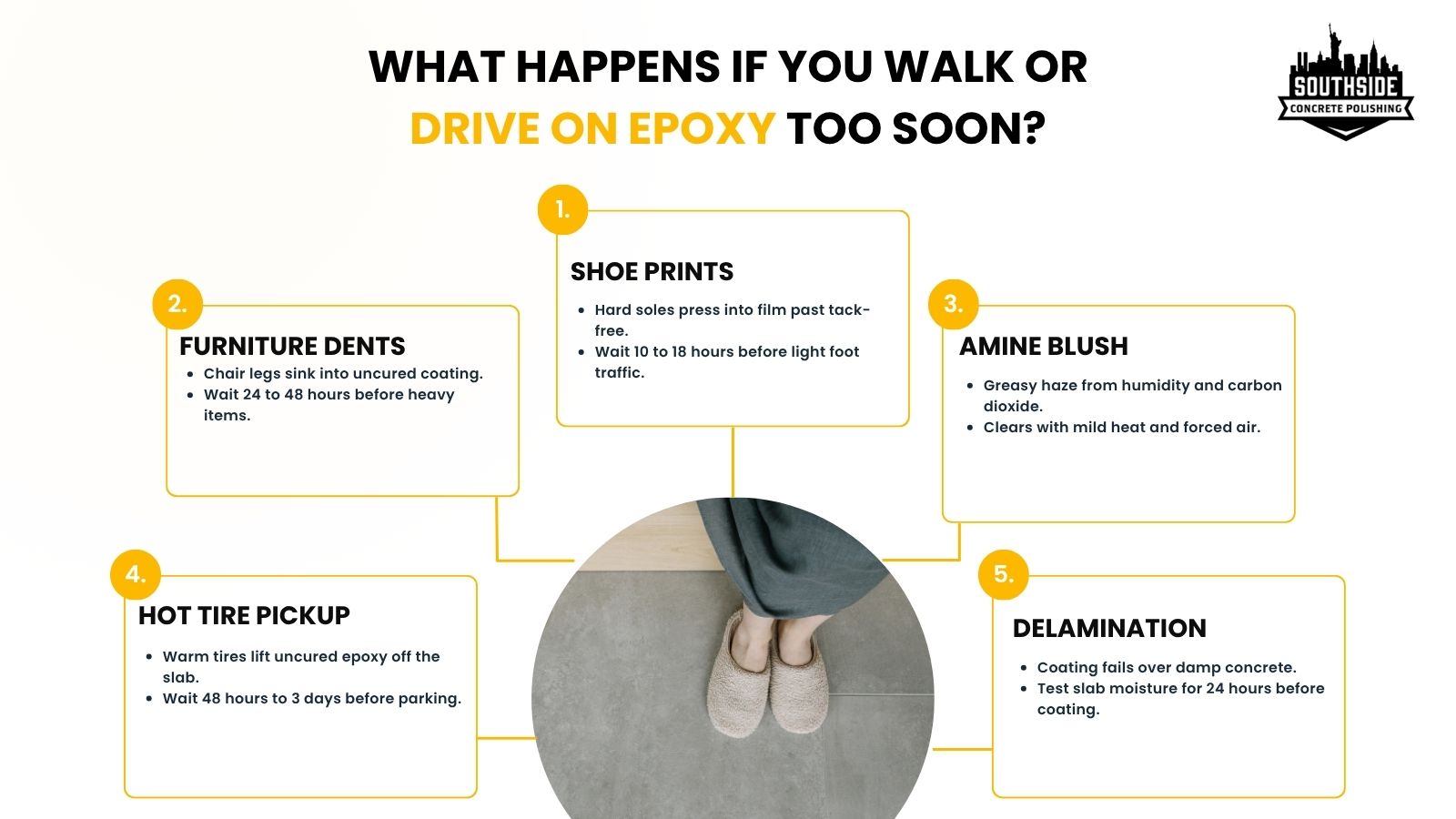
Early loading and poor cure conditions produce 3 epoxy damage types: surface marks from early traffic, tackiness and amine blush from undercure or humidity, and hot tire pickup or delamination.
Surface Marks From Early Foot Traffic
Early foot traffic leaves 3 common marks on epoxy:
- Shoe prints: Hard soles press into a film that sits past tack-free but short of dry-hard.
- Furniture dents: Chair legs and shelving feet sink into the coating before the 24 to 48 hour heavy-item milestone on Rust-Oleum EpoxyShield.
- Drag scuffs: Rolled or dragged loads tear the soft layer beneath the hardened epoxy skin.
Tacky Epoxy and Amine Blush
Amine blush is a hazy, greasy film that forms when aliphatic amine hardeners react with carbon dioxide and moisture in the air, according to Astro Chemical. Blush is a surface effect and does not stop the epoxy beneath from curing.
The 3 signs that separate amine blush from true undercure are:
- Greasy, cloudy film over a hard surface: This is amine blush, which clears with mild heat and forced air, according to Astro Chemical.
- Sticky or gummy film past 48 hours at 70°F: This is undercure, caused by an incorrect resin-to-hardener ratio or a slab below the application minimum.
- Soft patches in isolated areas: This is incomplete mixing, where unreacted resin or hardener sits in one section of the floor.
Hot Tire Pickup and Delamination
The 3 epoxy bond failures are:
- Hot tire pickup: Warm tires lift patches of uncured epoxy off the slab, which happens when vehicles park before the published vehicle milestone.
- Delamination: The Interstate Technology and Regulatory Council (ITRC) identifies delamination as the failure of epoxy floor coatings applied to damp concrete or slabs with high moisture vapor emission rates.
- Outgassing bubbles: Watco states that a single coat over bare concrete risks bubbles from air escaping pinholes and voids in the slab during cure.
Each of these epoxy failures traces back to a condition that stays controllable during cure.
How Can You Make an Epoxy Floor Cure Correctly?
To make an epoxy floor cure correctly, hold the slab inside the printed temperature range, keep humidity and dew point in check, and load the floor only at each published milestone. The 7 steps for a correct epoxy floor cure are:
- Hold floor and air temperature between 60°F and 85°F for Rust-Oleum EpoxyShield, or inside the range printed on the product's data sheet.
- Keep the concrete surface at least 5°F above dew point, which Polytek sets as an application minimum.
- Run a dehumidifier to hold relative humidity under 85% during application and cure.
- Move air across the floor with fans on cool, humid days, since forced air clears amine blush faster, according to Astro Chemical.
- Apply each recoat inside the published window, since Rust-Oleum requires sanding before its clear topcoat goes over EpoxyShield after 5 days.
- Relocate occupants away from the work area and keep it ventilated until the epoxy fully cures, typically 24 to 48 hours, according to the ITRC.
- Sweep dry for the first 5 days, the wait Watco sets before detergent washing High Build Epoxy 100.
A floor cured on schedule reaches the upper end of epoxy floor service life, because early damage and weak bonds are the failures that shorten it.
How Does Southside Concrete Polishing Prepare Slabs for Epoxy Cure?
Southside Concrete Polishing diamond grinds and moisture tests every slab before any epoxy goes down. That preparation targets the 2 bond failures covered above: delamination over damp concrete and weak adhesion over an unprepared surface.
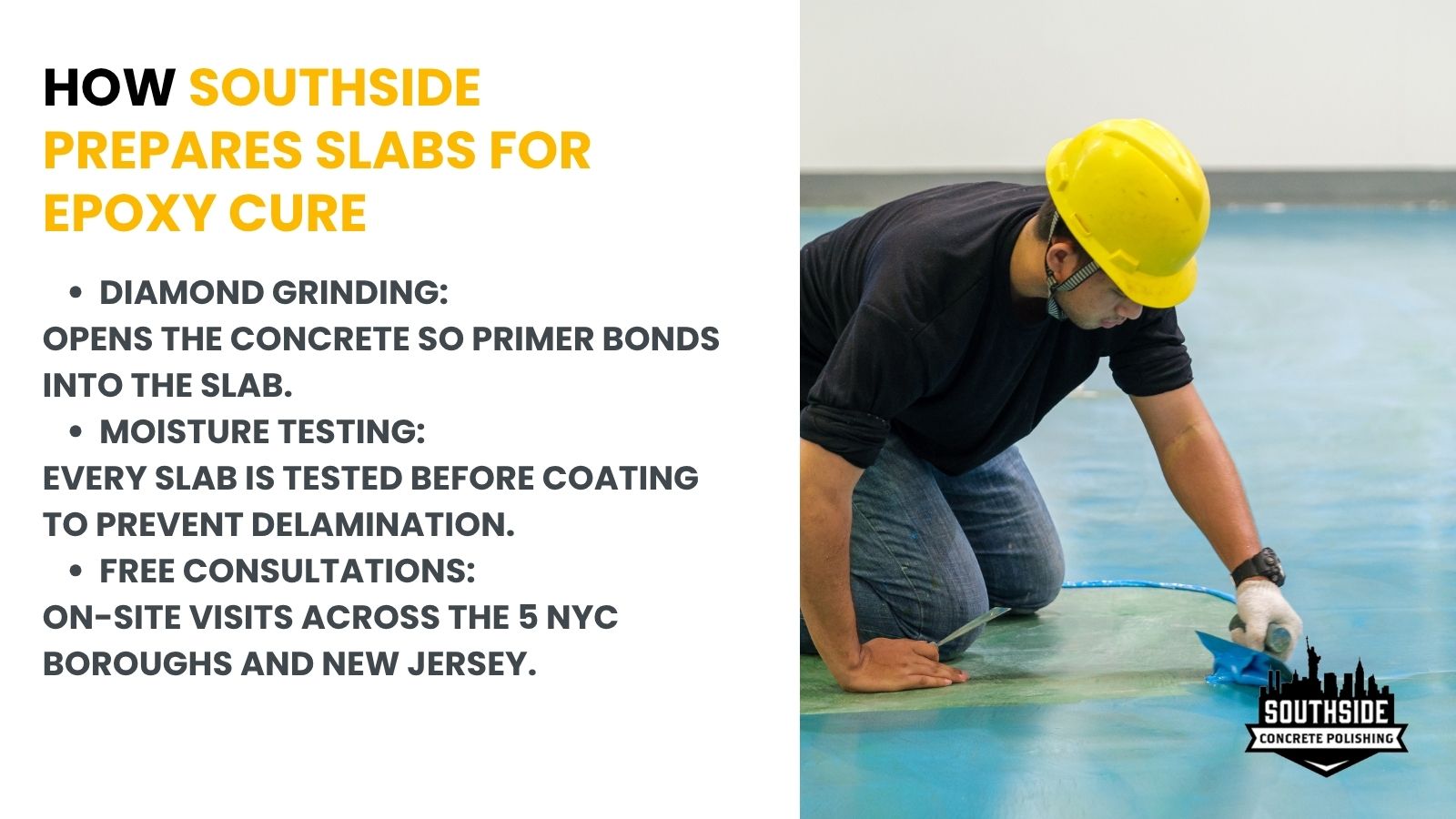
Diamond grinding removes the top layer of concrete with rotating abrasive discs, opening the surface so primer and base coat bond into the slab. Moisture testing confirms that vapor rising through the concrete stays within the coating's limit before application.
Southside Concrete Polishing offers diamond-ground commercial epoxy systems in self-leveling, flake, quartz, and ESD-resistant options for warehouses, garages, and commercial facilities. ESD-resistant epoxy is a static-dissipative coating that protects electronics from electrostatic discharge.
Brothers Jesse and Alex Logerfo founded the family-owned company in 2015. Southside Concrete Polishing provides free on-site consultations across the 5 New York City boroughs and New Jersey.
Frequently Asked Questions
Why is my epoxy floor still sticky after 48 hours?
An epoxy floor that stays sticky 48 hours after application at 70°F is undercured, most often from an incorrect resin-to-hardener ratio, incomplete mixing, or a slab below the 60°F application minimum. A greasy film over a hard surface is amine blush instead, which clears with mild heat and forced air, according to Astro Chemical.
Can you epoxy a garage floor in one day?
Yes, for single-coat kits only. Rust-Oleum EpoxyShield applies in 1 day but still needs 3 days before parking. A standard two-coat epoxy system needs 2 working days, because the topcoat goes on 10 to 24 hours after the base coat on Watco High Build Epoxy 100.
When can furniture go back on a new epoxy floor?
Furniture and heavy items go back on Rust-Oleum EpoxyShield 24 to 48 hours after application at 70°F and 50% relative humidity. Felt pads under chair legs and shelving feet spread point loads while the film finishes curing, and dragging stays off the floor until the 3-day full cure.
How long should you wait to mop a new epoxy floor?
Detergent mopping waits 5 days on Watco High Build Epoxy 100, according to Watco's technical data sheet. Dry sweeping and dust mopping remove grit before then without exposing the curing film to cleaning chemicals.
Does a heater or fan make epoxy cure faster?
Yes, heat speeds epoxy curing, since the cure rate doubles with each 18°F rise, according to Chemco Systems. Fans move humid air off the surface and clear amine blush faster. Open-flame heaters release water vapor and carbon dioxide, the two compounds that form amine blush.
Does humidity slow epoxy floor drying?
Yes, high humidity slows epoxy floor drying and produces amine blush on epoxies cured with aliphatic amine hardeners, according to Astro Chemical. Polytek and Concrete Floor Solutions set 85% relative humidity as the application ceiling.
Do basement epoxy floors take longer to cure than garage floors?
Basement epoxy floors take longer to cure when the slab runs cooler or carries more moisture vapor than a garage slab. A 24-hour plastic-sheet moisture test shows whether vapor rising through the basement slab needs a moisture barrier before coating.
How long should people stay out of a room while epoxy cures?
Occupants stay away from the work area until the epoxy fully cures, typically 24 to 48 hours after application, according to the ITRC. The area stays well ventilated for that full period, and occupants who cannot leave the building move to spaces away from the coated room.
References
- National Weather Service New York, NY. (2024). Central Park, NY daily climate normals: Maximum temperature (°F), 1991–2020. National Oceanic and Atmospheric Administration. https://www.weather.gov/media/okx/Climate/CentralPark/DailyMaxTNormals.pdf
- National Weather Service New York, NY. (2024). Central Park, NY daily climate normals: Minimum temperature (°F), 1991–2020. National Oceanic and Atmospheric Administration. https://www.weather.gov/media/okx/Climate/CentralPark/DailyMinTNormals.pdf
- ASTM International. (2022). Standard test methods for drying, curing, or film formation of organic coatings (ASTM D1640/D1640M-14(2022)). ASTM International.
- Rust-Oleum Corporation. (n.d.). EpoxyShield garage floor coating [Product application instructions]. Rust-Oleum.
- Rust-Oleum Corporation. (n.d.). EpoxyShield clear finish floor coating kit (Technical Data ESH-38). Rust-Oleum.
- Rust-Oleum Corporation. (n.d.). RockSolid polycuramine garage floor coating kit [Product listing]. Rust-Oleum.
- Watco Industrial Flooring. (n.d.). High Build Epoxy 100 standard and anti-slip [Technical data sheet]. Watco.
- Concrete Floor Solutions. (2023). CFS high performance epoxy top coat [Technical data sheet]. Concrete Floor Solutions.
- Polytek Development Corp. (n.d.). Premium floor coating epoxy, clear [Technical data sheet]. Polytek.
- Interstate Technology and Regulatory Council. (n.d.). Epoxy floor coating tech sheet. Vapor Intrusion Mitigation Team, ITRC.
- Chemco Systems. (2024). Cold weather (low temperature) epoxy curing tips. Chemco Systems.
- Astro Chemical. (2023). How temperature and humidity impact cure. Astro Chemical Company.