How to remove epoxy floor coatings from concrete comes down to mechanical removal: diamond grinding or shot blasting the cured resin off with dust collection running. Cured epoxy bonds into the top layer of the slab, so surface cleaning alone leaves the coating in place.
The right removal method depends on 3 factors: the coating's thickness, the size of the space, and the finish going down next. Each factor points to a different machine and a different end result on the concrete.
Key Takeaways
- The U.S. Environmental Protection Agency (EPA) prohibited methylene chloride paint and coating removers for consumer use in 2019, and EPA counts at least 88 deaths from acute methylene chloride exposure since 1980.
- The Occupational Safety and Health Administration (OSHA) names 2 dust controls for floor grinders on concrete: a continuous water feed, or a vacuum dust collector with a filter rated at 99% efficiency or higher.
- Diamond grinding and shot blasting are the 2 primary methods for removing cured epoxy, and both leave the concrete profiled for the next coating.
- The International Concrete Repair Institute (ICRI) rates concrete surface profile from CSP 1 to CSP 10, with grinding matched to CSP 2 and light shot blasting to CSP 3.
Is Epoxy Flooring Easy to Remove?
No, cured epoxy flooring is difficult to remove because the resin cross-links into a rigid solid bonded into the pores of the concrete slab. Epoxy is a thermoset polymer, a plastic that sets permanently through a chemical reaction instead of drying.
Cross-linking is that reaction, in which hardener molecules lock resin chains into a three-dimensional network that does not reverse. The bond line is the zone where the coating grips the concrete, and it holds hardest on floors that were properly profiled before installation.
Epoxy removal difficulty scales with coating thickness. Removing epoxy paint from concrete is the easier case, because water-based epoxy floor paint forms a thin film. 100% solids and broadcast flake systems build several layers that take longer to grind off.
Coating thickness matters most once a floor shows the failure signs that call for full removal.
When Does an Epoxy Floor Need to Be Removed?
An epoxy floor needs full removal when the coating has lost its bond to the concrete across the floor, because a coating that is releasing from the slab keeps failing wherever it lifts. There are 5 failure signs that call for full epoxy coating removal:
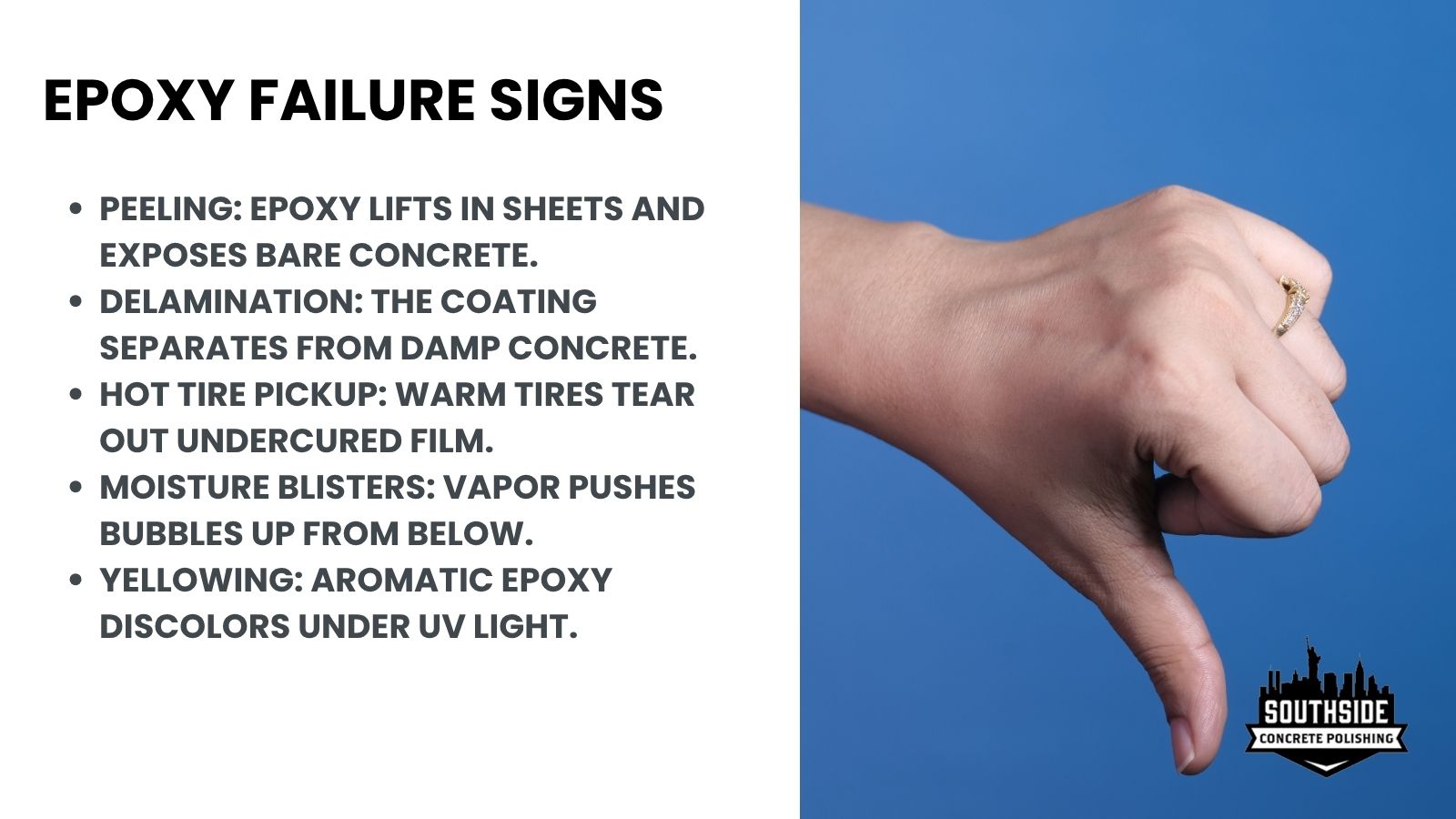
- Peeling: Sheets or flakes of epoxy lift away and expose bare concrete underneath.
- Delamination: The coating separates from the slab across wide areas, a failure the Interstate Technology and Regulatory Council (ITRC) links to epoxy applied over damp concrete or slabs with high moisture vapor emission.
- Hot tire pickup damage: Patches tear out where warm tires softened an undercured film and lifted it off the slab.
- Moisture blisters: Raised bubbles form where water vapor rising through the concrete pushes against the coating from below.
- Yellowing: Aromatic epoxies discolor under ultraviolet light on floors near windows and open garage doors.
Old epoxy on a garage floor shows peeling and hot tire pickup first, because vehicle tires load the coating harder than foot traffic. Every one of these signs of epoxy floor failure traces to slab moisture, surface preparation, or cure conditions at installation.
Once full removal is the call, the coating's thickness and the size of the space decide the removal method.
What Is the Best Way to Remove Epoxy from Concrete?
Diamond grinding is the best way to remove epoxy from concrete on most floors, and shot blasting suits thick coatings across large open slabs. Both methods leave a profiled surface that ICRI rates on its 10-point Concrete Surface Profile (CSP) scale.
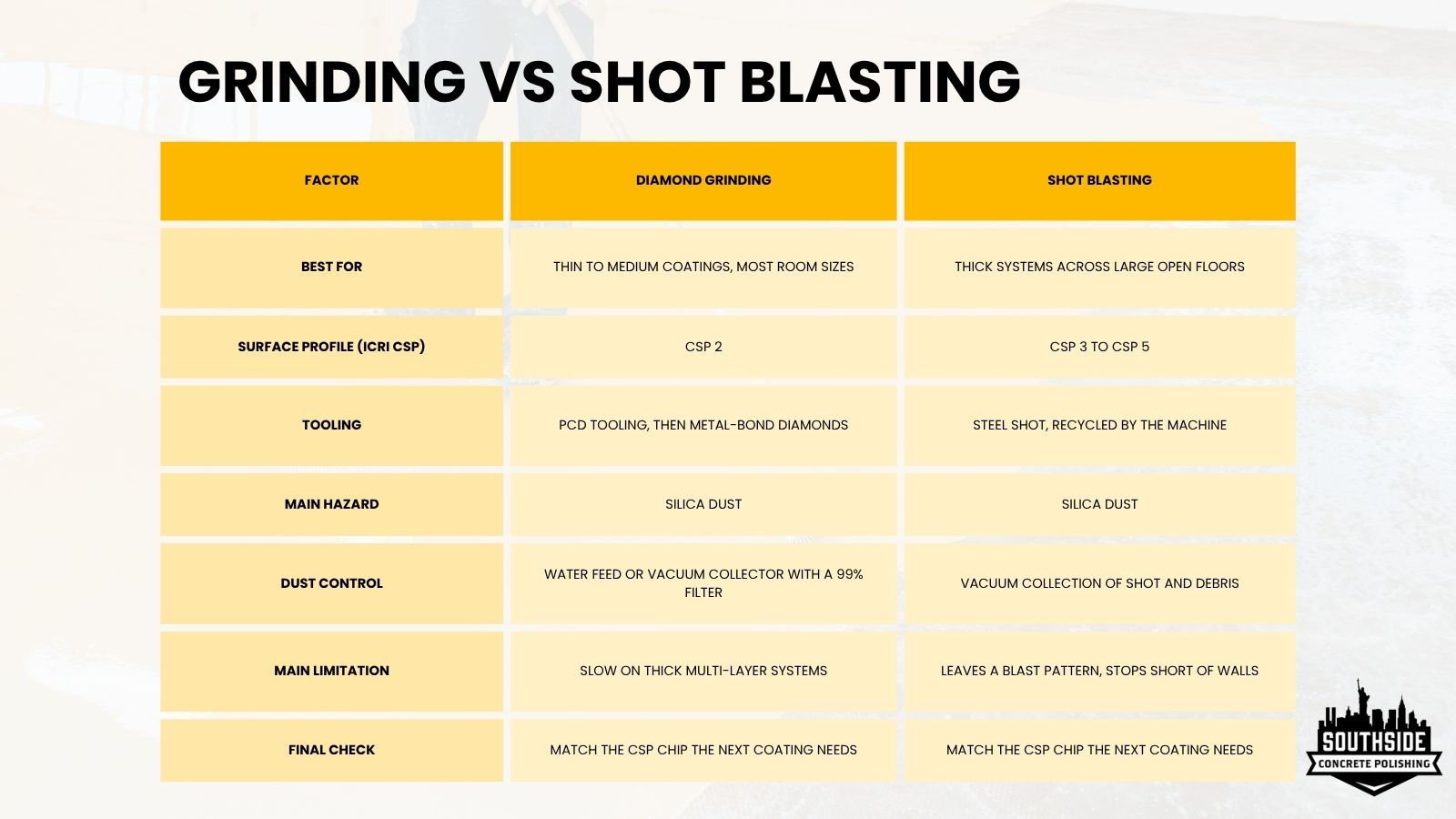
The table below compares the 4 epoxy coating removal methods by best use, the CSP each leaves, the main hazard, and the main limitation. "Not rated" marks a method ICRI does not assign a profile.
| Method | Best for | Surface profile left (ICRI CSP) | Main hazard | Main limitation |
|---|---|---|---|---|
| Diamond grinding | Thin to medium coatings, most room sizes | CSP 2 | Silica dust | Slow on thick multi-layer systems |
| Shot blasting | Thick systems across large open floors | CSP 3 to CSP 5 | Silica dust | Leaves a blast pattern and stops short of walls |
| Floor scraper | Thick or already delaminating coatings | Not rated | Low | Leaves residue that needs grinding |
| Chemical stripper | Small areas where machines do not fit | Not rated | Solvent fumes | Slow, product-dependent, leaves residue |
Diamond Grinding
Diamond grinding is the standard way crews remove epoxy from concrete, using a planetary floor grinder, a machine that spins several diamond-tooled heads against the slab at once. Polycrystalline diamond (PCD) tooling cuts through the coating first, and metal-bond diamonds then refine the concrete to the target profile.
ICRI Guideline 310.2R-2013 matches grinding to CSP 2, a smooth profile suited to thin coatings and sealers. Grinding releases silica dust from the concrete, which sets the dust controls covered in the next section.
Shot Blasting
Shot blasting removes epoxy by firing steel shot at the floor, and the machine vacuums the shot back up for reuse while collecting the debris. ICRI places light shot blasting at CSP 3 and medium shot blasting at CSP 5, rougher profiles that thick coatings and overlays bond to.
Chemical Strippers
Chemical epoxy strippers soften a cured coating so the softened layer scrapes off, and they suit small areas where grinding is impractical. Stripping works slowly on thick systems and leaves residue that needs a final grind.
Methylene chloride is the stripper chemistry to avoid. The EPA's 2019 rule on methylene chloride paint removers prohibits those products for consumer use, and EPA counts at least 88 deaths from acute exposure since 1980, mostly among workers stripping paint and refinishing bathtubs.
A broader 2024 EPA rule covering commercial uses was vacated by the U.S. Court of Appeals for the Fifth Circuit on September 15, 2026. That ruling addressed the 2024 rule, not the 2019 consumer paint remover rule.
Grinding and blasting avoid solvent hazards entirely, and their dust hazard has a defined federal control standard.
How Do You Control Dust When Grinding Epoxy Off Concrete?
OSHA controls floor-grinder dust with one of 2 engineering methods: an integrated water system that wets the cutting surface, or a vacuum dust collection system with a filter rated at 99% efficiency or higher. The OSHA silica standard for construction, 29 CFR 1926.1153, sets those controls.
Respirable crystalline silica is the fine quartz dust released when concrete is ground or blasted. The standard caps worker exposure at 50 micrograms per cubic meter of air over an 8-hour shift, with an action level of 25 micrograms that triggers exposure assessment.
The 5 dust controls OSHA sets for walk-behind floor grinders are:
- Water or vacuum capture: A continuous water feed reaches the grinding surface, or a commercial vacuum dust collection system captures dust at the cutting point.
- Matched equipment: A shroud and vacuum recommended by the grinder manufacturer run with a filter-cleaning mechanism.
- HEPA cleanup between passes: A HEPA-filtered vacuum removes loose dust between passes on indoor jobs.
- No compressed air: Blowers and compressed air stay off surfaces unless a ventilation system captures the dust cloud.
- No dry sweeping: Wet methods or HEPA vacuuming replace brooms wherever sweeping adds exposure.
OSHA Fact Sheet 3932 states that Table 1 requires no respirator for walk-behind grinders when water or vacuum collection runs as specified. Water-fed grinding also calls for ground-fault circuit interrupters (GFCIs) and watertight connectors, since water and power share the floor.
The silica standard binds employers, and professional crews follow it on every grinding job. The same controls protect anyone grinding concrete inside an occupied home or attached garage.
How to Remove an Epoxy Floor Coating Step by Step
To remove an epoxy floor coating, clear and seal the space, match the method to the coating, and run dust collection from the first pass to the final inspection. The 7 steps of epoxy floor removal are:
- Clear the floor completely and seal doorways and vents with plastic sheeting to contain dust.
- Test a small patch with the chosen machine to judge coating thickness and bond strength.
- Choose diamond grinding, shot blasting, or stripping from the comparison table based on that test.
- Connect the dust collector or water feed before the first pass, following the grinder manufacturer's setup.
- Remove the coating in overlapping passes until no gloss or resin remains on the open floor.
- Vacuum the slab with a HEPA-filtered vacuum instead of sweeping.
- Inspect the exposed concrete against the target ICRI CSP chip before any new finish goes down.
Epoxy floor removal on a garage or basement slab follows the same 7 steps as a warehouse floor, with a smaller machine. Knowing how to remove epoxy floor coatings in this order keeps dust contained and the slab ready for inspection.
What Should Concrete Look Like After Epoxy Removal?
After epoxy removal, concrete shows a clean, uniform profile that matches the ICRI CSP the next coating requires, with no gloss or leftover resin. The 4 checks before a new finish goes down are:
- Profile match: The slab texture matches the CSP chip named on the next product's technical data sheet.
- Resin-free surface: No shiny patches or resin film remain, including in low spots.
- Moisture test: A 2-foot by 2-foot plastic sheet taped to the slab for 24 hours shows no condensation, the test Rust-Oleum specifies before coating.
- Crack repair: Cracks and spalls exposed by removal are filled before the finish goes down.
Bare concrete after epoxy removal takes 2 paths. A new resinous coating follows the full sequence for recoating bare concrete with epoxy and then its own epoxy dry and cure schedule, while a mechanical finish uses the ground slab itself, with polished concrete as the next finish.
How Does Southside Concrete Polishing Prepare Slabs for a New Floor?
Southside Concrete Polishing diamond grinds and moisture tests every slab before a new floor goes down. That preparation is the same work a slab needs after epoxy removal: a uniform profile and confirmed moisture levels.
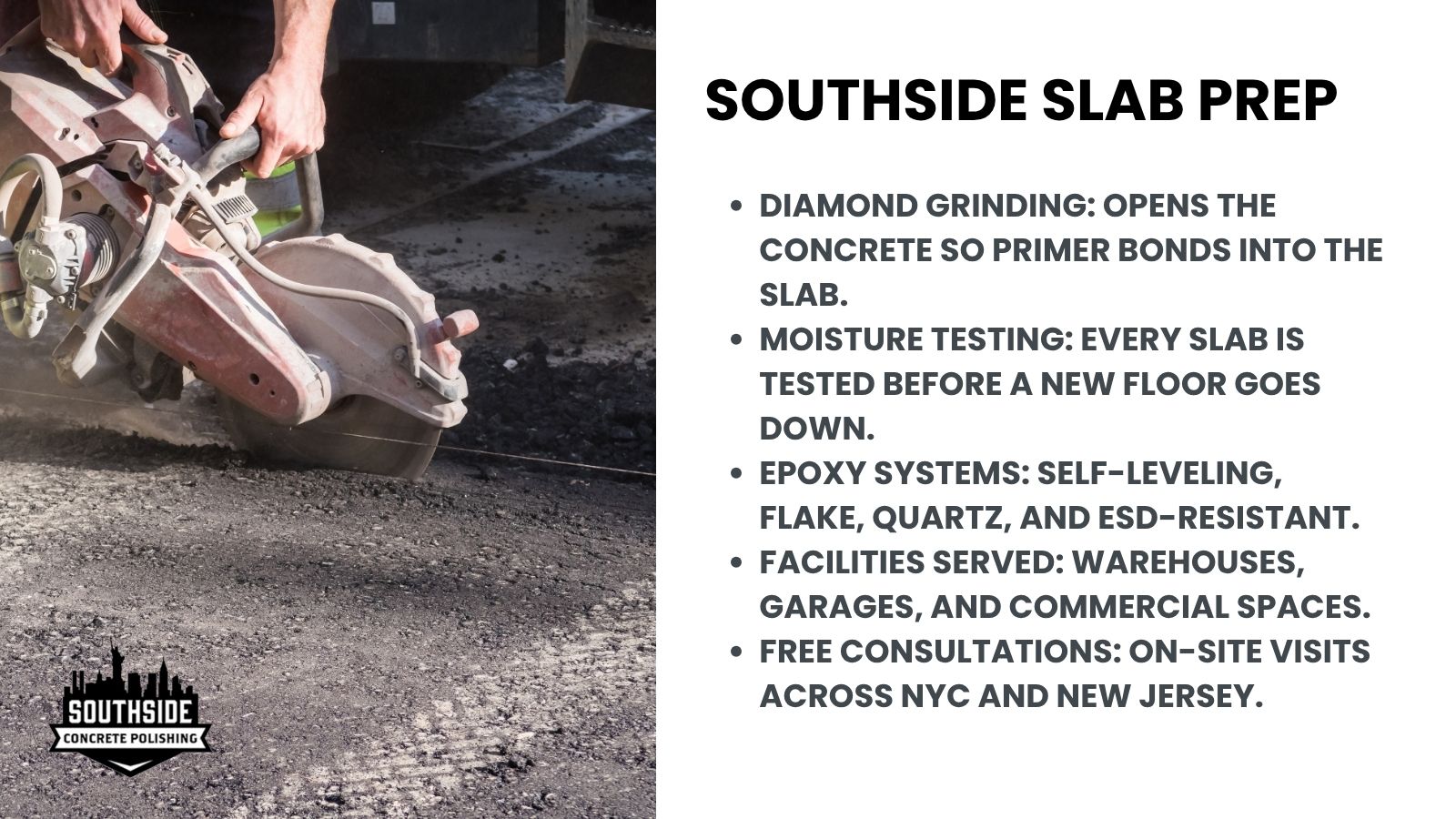
Diamond grinding removes the top layer of concrete with rotating abrasive discs, opening the surface so primer and base coat bond into the slab. Moisture testing confirms that vapor rising through the concrete stays within the next coating's limit.
Southside Concrete Polishing installs diamond-ground commercial epoxy systems in self-leveling, flake, quartz, and ESD-resistant options for warehouses, garages, and commercial facilities. ESD-resistant epoxy is a static-dissipative coating that protects electronics from electrostatic discharge.
Brothers Jesse and Alex Logerfo founded the family-owned company in 2015. Southside Concrete Polishing provides free on-site consultations across the 5 New York City boroughs and New Jersey.
Frequently Asked Questions
Can new epoxy go over old epoxy instead of removing it?
Yes, new epoxy goes over old epoxy when the existing coating is sound and well bonded to the concrete. Sherwin-Williams' Resuprime SS (Super-Stick) tech tip calls for cleaning and degreasing the old floor, then mechanically abrading it by shot blasting, grinding, or sanding until all gloss is gone. The RIO-COAT EPT data sheet specifies sanding with 80-grit paper or a 60-grit screen before recoating.
Will acetone remove a cured epoxy floor coating?
No, acetone does not remove a cured epoxy floor coating. Curing cross-links epoxy resin into a thermoset solid that resists common solvents, so a fully cured coating comes off concrete only through mechanical removal.
Can a heat gun remove epoxy from concrete?
Yes, a heat gun removes small areas of cured epoxy, not whole floors. The WEST System user manual directs heating a small section to about 250°F, scraping off the softened coating, and sanding away what remains. The method suits patches and thresholds, while full floors call for grinding.
How do you remove epoxy along edges and corners?
Epoxy along edges and corners comes off with a handheld grinder, since walk-behind machines stop short of walls. OSHA pairs handheld grinders with a shroud and a dust collector moving at least 25 cubic feet per minute per inch of wheel diameter through a 99% efficient filter. Water-fed handheld grinding is limited to outdoor work.
How do you remove uncured or tacky epoxy from concrete?
Uncured epoxy comes off concrete by scraping first and cleaning the residue with a solvent. The WEST System user manual directs scraping as much material as possible, warming the epoxy to lower its viscosity, and cleaning with lacquer thinner, acetone, or alcohol under adequate ventilation.
What should you do with epoxy scrapings after removal?
Cured epoxy scrapings in small quantities are a non-hazardous inert solid, according to the WEST System user manual. The same manual recommends curing leftover mixed resin before disposal, and local solid waste rules govern the larger volumes that full-floor removal produces.
References
- U.S. Environmental Protection Agency. (2019). EPA bans consumer sales of methylene chloride paint removers, protecting public [News release].
- U.S. Environmental Protection Agency. (2024). Biden-Harris Administration finalizes ban on most uses of methylene chloride, protecting workers and communities from fatal exposure [News release].
- East Fork Enterprises, Inc. v. U.S. Environmental Protection Agency, Nos. 24-60227 & 24-60256 (5th Cir. Sept. 15, 2026).
- Occupational Safety and Health Administration. (n.d.). 29 CFR 1926.1153, Respirable crystalline silica. U.S. Department of Labor.
- Occupational Safety and Health Administration. (2017). Control of silica dust in construction: Walk-behind milling machines and floor grinders (Fact Sheet 3932). U.S. Department of Labor.
- Occupational Safety and Health Administration. (n.d.). Control of silica dust in construction: Handheld grinders for tasks other than mortar removal (Fact Sheet 3628). U.S. Department of Labor.
- Occupational Safety and Health Administration. (2019). Standard interpretation: Types of construction work excluded from the silica standard. U.S. Department of Labor.
- International Concrete Repair Institute. (2013). Guideline 310.2R-2013: Selecting and specifying concrete surface preparation for sealers, coatings, polymer overlays, and concrete repair. ICRI.
- Interstate Technology and Regulatory Council. (n.d.). Epoxy floor coating tech sheet. Vapor Intrusion Mitigation Team, ITRC.
- Gougeon Brothers, Inc. (2015). WEST System user manual and product guide. WEST System.
- Sherwin-Williams Industrial Coatings. (n.d.). Save steps with Resuprime SS (Super-Stick) [Technical tip]. Sherwin-Williams.
- RIO Flooring. (2025). RIO-COAT EPT [Technical data sheet]. RIO Flooring.
- Rust-Oleum Corporation. (n.d.). EpoxyShield garage floor coating [Product application instructions]. Rust-Oleum.